


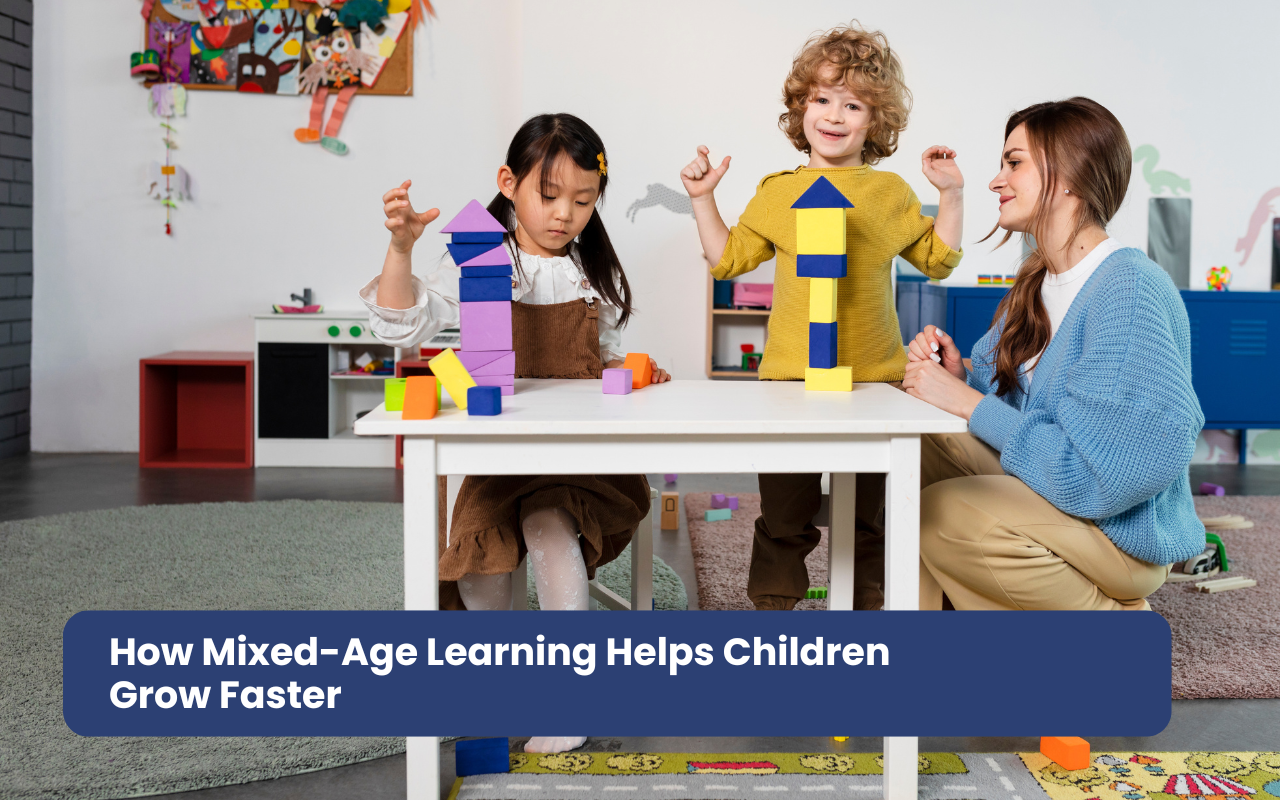
Walk into a room where toddlers and slightly older kids are learning together. You notice the difference almost immediately, not because it’s louder or quieter, but because the pace feels more fluid, with a younger child watching while an older one tries to explain something in their own way, not perfectly, but in a way that still makes sense.
Mixed-age settings don’t push everyone into the same pattern, and that shifts how children respond, how they pick things up, and how they interact with each other over time.
This article explores how mixed-age learning shapes social skills, emotional growth, and early development in ways that feel closer to how children naturally learn.
What Is Mixed-Age Learning?
Mixed-age learning is exactly what it sounds like. Children of different ages share the same learning space rather than being strictly grouped by birth year.
You’ll often see this in thoughtfully designed daycare programs. In places like Daycare in Arlington, WA, this model is becoming more common because it reflects how children actually learn outside structured systems.
In these settings, older kids aren’t just learners. They become helpers, observers, sometimes even quiet mentors. Younger children, on the other hand, absorb more than we usually give them credit for.
That’s where many of the benefits of mixed-age learning begin to show up.
Key Benefits of Mixed-Age Learning
Faster Social Development
Children don’t learn social skills through instructions alone. They pick them up through interaction, observation, and a bit of trial and error.
In mixed-age classrooms, younger children are constantly exposed to more advanced communication. They hear longer sentences, watch problem-solving unfold, and slowly start imitating it.
At the same time, older children start adjusting how they communicate, simplifying their words, slowing down, and showing a bit more patience, often without realizing they’re doing it. That back-and-forth creates a quiet shift, where both sides become more aware of each other, and social understanding develops in a way that feels less forced than in same-age groups.
It’s one of those mixed-age learning benefits that becomes obvious only when you compare environments.
Natural Leadership Skills in Older Children
Something is interesting about how responsibility shows up without being formally assigned in these settings. Older children often step into that space on their own, helping a younger child stack blocks or trying to explain why something didn’t work, not always getting it right, but still learning through the process.
That act of explaining tends to reinforce their own understanding, even when it’s a bit messy, and while there are moments when they don’t feel like helping, that’s part of the dynamic too.
Over time, though, you start to notice a shift, where confidence builds more quietly, not attention-seeking but steady, and it’s one of those mixed-age learning benefits that tends to stay with them.
Personalized Learning Pace
Not every child moves at the same pace: some push ahead quickly, while others take their time, circling back before moving forward again. That variation is usually harder to accommodate in more structured setups.
Mixed-age learning doesn’t try to correct it: it simply makes space for it, allowing children to engage at their own speed without being pulled into a fixed timeline.
In mixed-age learning environments, younger children encounter more advanced ideas without pressure to master them right away. In comparison, older children revisit basics as they guide others, reinforcing their own understanding.
That overlap softens the usual tension of moving too fast or too slow and gradually shapes a more flexible approach to learning overall.
Stronger Emotional Intelligence
Spending time with different age groups asks children to read situations a bit more closely. A toddler’s frustration doesn’t look the same as a five-year-old’s, and older children start to pick up on those differences and adjust how they respond, even if they can’t fully explain it.
Younger children, in turn, receive guidance that feels more relatable than authoritative, which changes how they respond and engage in the moment.
There’s more empathy in these interactions, more patience, and, at times, more conflict, too, which is part of how emotional understanding develops.
Over time, these small exchanges shape how children handle relationships, which is why mixed-age learning benefits are often linked to stronger emotional growth.
Reduced Competition and Stress
When children are grouped by age, comparisons tend to happen almost without thinking, with attention drifting to who reads faster, who finishes first, or who gets the answer right.
Mixed-age setups ease that pattern, shifting the focus away from comparison and toward participation, where younger children aren’t expected to keep up with older ones and older children aren’t measuring themselves against peers in quite the same way.
The overall feel becomes a bit calmer, with less pressure and fewer labels shaping how children see themselves. Children still challenge themselves, but it comes through their own pace rather than something that feels imposed.
How Mixed-Age Learning Supports Brain Development
Learning Through Observation
Children are always watching, often taking in more than we realise without any direct instruction, and in mixed-age settings, that observation becomes a central part of how they learn, with a younger child quietly watching an older one complete a task, not being corrected or guided in the moment, just observing.
Later, they try it themselves, drawing from what they’ve seen rather than what they’ve been told. That kind of passive learning supports cognitive development by strengthening memory, attention, and pattern recognition without making the experience feel like a test.
It’s one of the more understated benefits of mixed-age learning, but arguably one of the most impactful.
Repetition Benefits for Older Kids
Teaching something to someone else helps children understand it more clearly, which is why older kids in mixed-age groups often revisit basic concepts while helping younger ones. Even if it looks like repetition at first, it works differently in practice.
They’re not just repeating steps; they’re explaining, demonstrating, and adjusting based on the other child’s responses, which makes the process more active and engaging.
This dynamic is one of the reasons mixed-age classrooms often show stronger retention over time.
Why Mixed-Age Daycare Feels More Like a Family
Sibling-Like Environment
Mixed-age groups tend to develop a kind of familiarity that feels closer to a shared space than a structured classroom, where children interact in ways that resemble siblings, not always smoothly, but in a way that feels real.
They help each other, disagree, laugh, sometimes drift apart, and then come back together, which builds a sense of comfort and belonging without relying too heavily on rules.
In many mixed-age learning environments, this family-like dynamic becomes one of the most valued parts of the experience.
Better Transition for Younger Children
Starting daycare can feel overwhelming with new faces, routines, and expectations, but having older children present changes how that transition unfolds.
Younger kids often find someone to observe and follow, not a teacher but a peer who feels easier to relate to, picking up small behaviours like where to sit or how to tidy up.
Over time, this makes the adjustment smoother, with less anxiety and fewer difficult moments, and eventually, they grow into that same role for others.
Is Mixed-Age Learning Right for Your Child?
Ideal for Different Personality Types
Children approach social settings differently: some step in easily, while others take time to get comfortable.
Mixed-age environments tend to accommodate both without forcing a single way of participating.
More outgoing children often take on active roles and interact widely, while quieter ones can observe first, join in gradually, and build confidence at their own pace, which creates a space where participation feels natural rather than expected.
Works Well for Early Childhood Development
Early childhood focuses less on fixed academic milestones and more on overall development, including language, social awareness, emotional regulation, and curiosity, and mixed-age learning supports these areas together rather than treating them separately.
Through everyday interactions, children develop multiple skills at once, which is often where parents begin to notice the longer-term benefits of mixed-age learning.
What to Look for in a Quality Mixed-Age Daycare
Not all mixed-age programs work the same way, and the setup makes a noticeable difference, especially when age groupings are planned with intention rather than left to chance.
The role of the teacher matters too: guiding interactions without controlling every moment, creating a balance between supervision and allowing children to figure things out on their own.
It also helps to watch how children interact within the space, whether older kids are encouraged to support others without feeling responsible for them, and whether younger children are given help without becoming overly reliant on it.
In a well-run Daycare Arlington parents trust, these details tend to show up clearly in how the environment feels and how children move within it.
Conclusion
Mixed-age learning doesn’t try to artificially speed things up. It creates conditions that allow growth to happen more naturally, shaped by everyday interactions rather than strict timelines.
Children learn from each other as much as they do from instruction, picking up social awareness, emotional understanding, and confidence through moments that don’t feel like formal lessons.
It isn’t without its challenges, but there’s a natural rhythm to it that aligns closely with how children tend to grow, and for many families, that’s what makes it feel right.
Looking for a nurturing space where your child can grow with confidence and comfort?
At Blancas Daycare De Colores, we offer a warm, mixed-age learning environment that supports every stage of early development.
Call us today at 707-210-4802 to learn more, schedule a visit, or discuss how we can support your child’s journey. A simple conversation can help you see the difference firsthand.
FAQ
Is mixed-age learning better than traditional classrooms?
It works differently. Many families prefer it for early development because it focuses on social and emotional growth alongside learning.
Can younger children keep up in mixed-age daycare?
They’re not expected to “keep up” in the usual sense. They learn through observation and gradual participation.
Do older children get bored in mixed-age groups?
Not usually. Teaching and helping others often deepens their own understanding.
What age groups work best for mixed-age learning?
Typically, groups within a 2–3 year age range work well, allowing interaction without large developmental gaps.
Is mixed-age daycare safe for infants and toddlers?
Yes, when properly supervised with structured yet flexible routines.
How does mixed-age learning improve social skills?
Children interact with a wider range of behaviors and communication styles, helping them adapt and respond more effectively.