

Children typically do not learn language in a formal way. Instead, they learn it while playing with blocks, pretending that their stuffed animal is talking to them, or singing a funny song that they only sort of remember. At some point, language development seems to occur. If two languages are involved in this type of learning, an interesting phenomenon is observed. Children never separate their play time from their learning time; they simply learn everything.
There are several things that parents often notice when their child is learning two languages. A child may answer a question in Spanish even though it was asked in English. A song that the child knows may change languages in the middle. This may seem chaotic, but it is actually an interesting way to look at how children naturally learn while playing.
This article looks at how bilingual play in early childhood development supports thinking, communication, and emotional growth, along with how childcare environments can nurture that process.
What Is Bilingual Play?
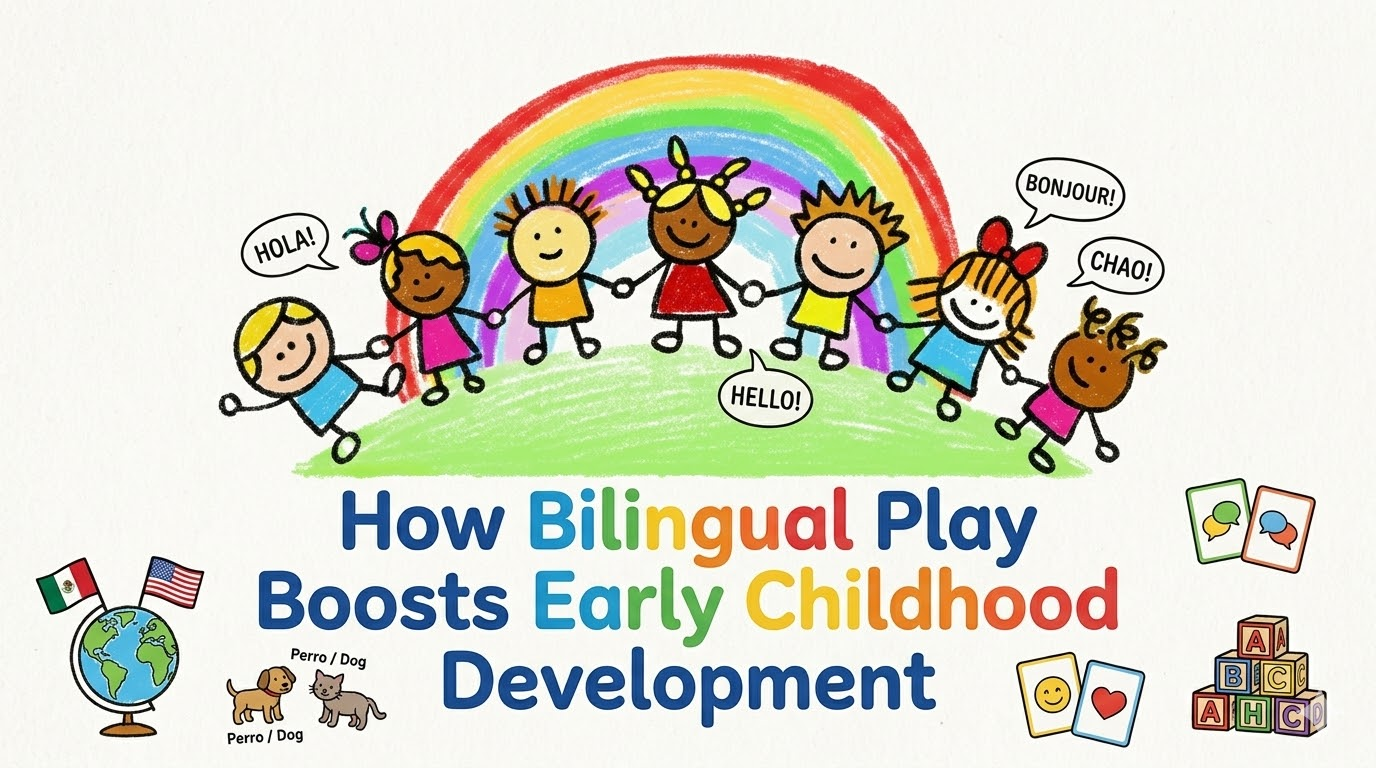
Bilingual play is exactly what it sounds like: children interacting, imagining, and exploring while hearing or using two languages. It may involve stories, songs, instructions, or conversations between children and their teachers, without any sense of formality being necessary.
In some classrooms, the use of language occurs almost imperceptibly with the other activities. For instance, the teacher might describe colors in English while children paint, then repeat them in Spanish. During snack time, a caregiver may name foods in both languages. Over time, those repeated exposures build familiarity.
Researchers often point out that bilingual play in early childhood development allows children to experience language through context rather than memorization. When a child hears “rojo” while holding a red crayon, the connection happens almost automatically.
And honestly, children rarely stop to think about it. They are too busy playing.
The Science Behind Early Bilingual Learning
Early childhood researchers often focus on the early years because the brain is unusually flexible during this stage. Language development is accelerated in young children, especially when they are exposed to verbal communication in everyday life.
Brain Development Benefits
When children grow up hearing more than one language, the brain practices switching between systems. This constant adjustment stimulates areas responsible for attention, memory, and mental flexibility.
Studies examining bilingual play in early childhood development show increased activity in regions tied to executive function. That sounds technical, though the result appears simple: children often become better at managing information and adapting to new situations.
Critical Learning Window
Young children do not approach language the way adults do. Adults analyze grammar rules. Kids imitate sounds, gestures, and tone of voice. Their brains treat language almost like music.
This period plays a major role in early childhood development, since exposure to two languages during these years tends to feel natural rather than overwhelming.
Neural Connections
Every new word builds a connection between sound, meaning, and memory. When two languages appear side by side, the brain builds more pathways linking those ideas.
Many researchers connect this process with the long-term benefits of bilingualism in children, including improved mental flexibility later in life.
Cognitive Benefits of Bilingual Play
Langage exposure through play shapes thinking patterns in ways that appear gradually.
Enhanced Problem-Solving Skills
Children exposed to two languages often practice shifting attention between different word sets and their associated meanings. This ability sometimes translates into stronger reasoning skills.
A puzzle, for example, may involve instructions in English while classmates discuss solutions in Spanish. That experience keeps the brain adjusting between two systems. Bilingual play in early childhood development quietly builds that mental flexibility.
Improved Memory & Concentration
Young bilingual learners often hold multiple vocabulary sets in memory at once. That process strengthens working memory.
Caregivers sometimes notice this during storytelling activities. Children remember character names, actions, and changes in language. It becomes part of the story rather than a challenge.
Stronger Academic Foundations
Early exposure to language diversity can support reading and comprehension skills later. When children recognize patterns between languages, they develop awareness of sounds, word structure, and meaning.
These patterns often support long-term early childhood development, particularly in literacy.
Social & Emotional Benefits
Language carries more than vocabulary. It carries culture, tone, and identity.
Better Communication Skills
Kids who experience bilingual learning often grow into more attentive listeners as they become accustomed to hearing and understanding two languages in everyday situations. They pay close attention to context and expression when interpreting meaning.
Over time, this attentiveness improves communication with peers and adults.
Increased Confidence
There is something quietly powerful about a child realizing they can speak with more people. A child who greets one teacher in English and another in Spanish often gains confidence from that flexibility.
Empathy & Cultural Awareness
Language opens a window into different cultural traditions and perspectives. Children hear different stories, celebrations, and expressions.
Through bilingual play in early childhood development, these cultural cues naturally emerge in games, songs, and shared activities.
Language Development Through Play
Play offers a relaxed environment where children experiment with language without pressure.
How Play Encourages Speech
Children speak more freely when they feel comfortable. During pretend play, a child may narrate actions or invent characters. That storytelling naturally expands vocabulary.
Many educators view play as the most natural path toward bilingual learning for kids because it invites conversation rather than instruction.
Blending Languages Naturally
Children frequently mix languages when they speak. Adults sometimes worry about this, though researchers generally see it as a normal step.
A child might say half a sentence in English, then finish it in Spanish. With continued exposure, the brain gradually organizes those languages more clearly.
Role of Teachers & Caregivers
Caregivers guide this process gently. They repeat phrases, introduce new words, and model both languages in everyday conversation.
In environments focused on bilingual play in early childhood development, teachers create opportunities for language to appear in songs, reading circles, and imaginative play.
Types of Bilingual Play Activities
Bilingual play can take many forms. Some examples include:
- Storytime where books alternate between English and Spanish
- Music and movement activities using songs from different cultures
- Role-playing games where children practice everyday phrases
- Art activities where colors and shapes appear in both languages
- Outdoor games that include simple instructions spoken in two languages
None of these activities requires complicated materials. The language simply becomes part of the experience. Families searching for childcare in Arlington often look for programs that support both language and play.
Parental Involvement: Encouraging Bilingual Play at Home
Parents often ask how they can support language development outside childcare settings. Small daily routines often make the biggest difference.
Reading books in two languages is one simple approach. Singing songs from family traditions also introduces vocabulary naturally. Some parents worry about consistency. Yet language exposure does not need to follow strict rules. What matters is that children hear both languages regularly while interacting with people they trust.
Sometimes a parent reads a bedtime story in Spanish while a sibling responds in English. Those mixed moments still contribute to bilingual play in early childhood development.
How Blancas Daycare De Colores Encourages Bilingual Learning
At Blancas Daycare De Colores, bilingual interaction appears throughout daily routines. Teachers introduce English and Spanish during storytime, creative activities, and everyday conversations. Children hear both languages while playing, sharing meals, and participating in group activities.
Parents exploring a daycare in Arlington sometimes notice how comfortable children become with switching languages during play. That comfort grows through repetition, interaction, and a supportive environment where language learning feels natural rather than structured.
Long-Term Impact of Bilingual Play
The effects of early bilingual exposure often continue well beyond preschool.
Children who experience bilingual play in early childhood development may show stronger adaptability in school environments that require complex thinking and communication. They also tend to develop curiosity about language and culture.
Sometimes those early experiences influence future academic interests. Other times, they simply give children the confidence to connect with people from different backgrounds.
Conclusion
Bilingual play incorporates language into everyday exploration. This way, children acquire language, culture, and thinking skills while doing what they already love: playing. When caregivers, teachers, and families support that process, language learning becomes something children carry with them naturally as they grow.
Give Your Child a Strong Start!
At Blancas Daycare De Colores, language learning grows naturally through play, conversation, and caring guidance. Children experience English and Spanish daily as they build confidence, curiosity, and friendships. If you are searching for a supportive bilingual environment for your child, reach out to us today.
Call us at 707-210-4802 to learn more about enrollment, programs, and how we help children grow through meaningful learning experiences.
FAQs (Frequently Asked Questions)
At what age should my child start bilingual learning?
Children can begin hearing multiple languages from infancy. Early exposure helps the brain become familiar with different sounds and patterns.
Will learning two languages confuse my child?
Language mixing is normal during the learning stage. With time and continued exposure, children usually separate the languages naturally.
How can parents support bilingual learning at home?
Reading books, singing songs, and speaking regularly in both languages can build familiarity and confidence.
Does Blancas Daycare De Colores teach in both English and Spanish?
Yes. Children experience both languages during play, storytelling, and everyday classroom interactions.
What if my child only speaks one language now?
That is completely fine. Children can begin learning another language at many stages during early childhood.